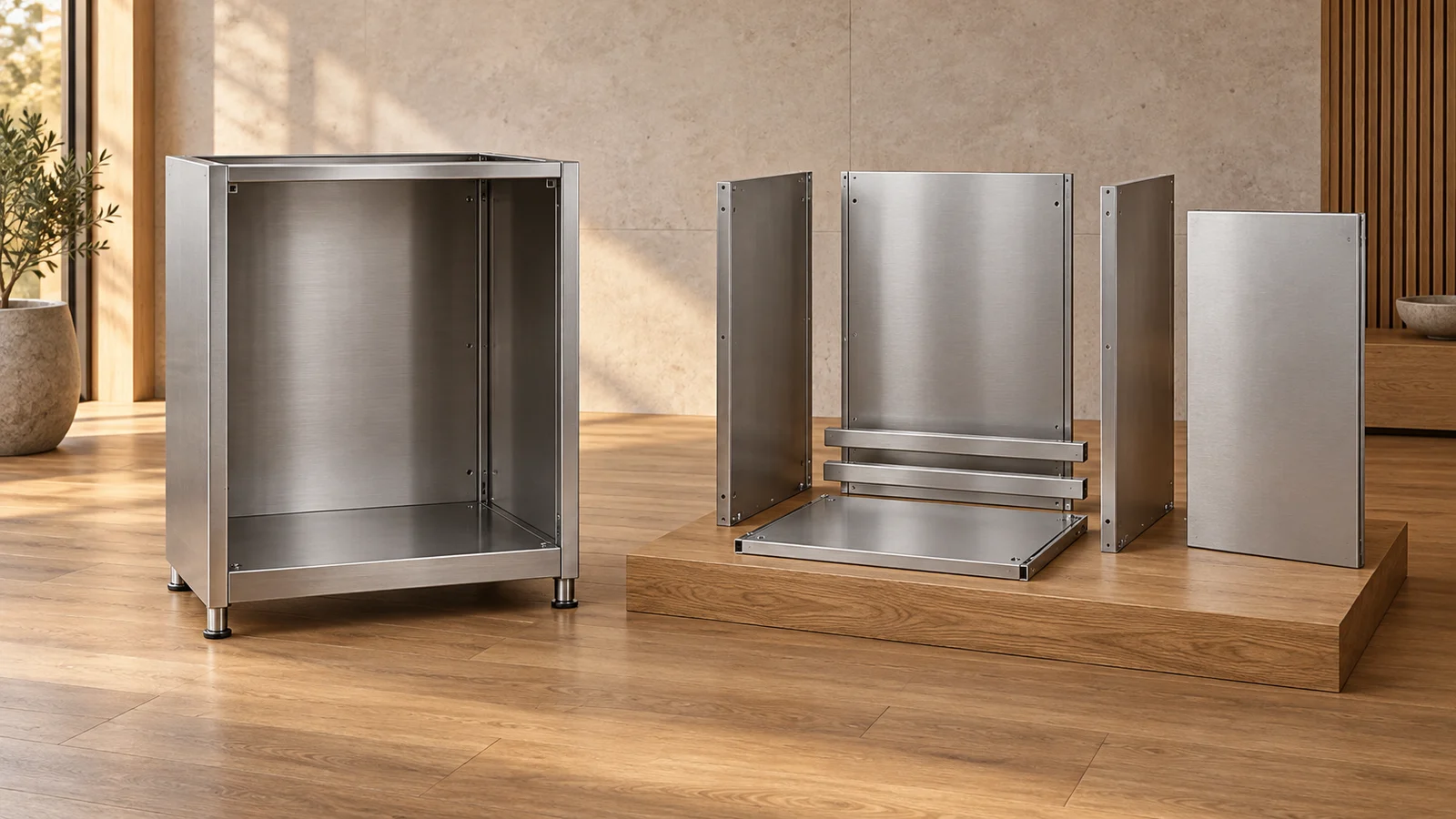
An overseas cabinet order has to work twice: when it leaves the factory and when it reaches the installation site. Buyers comparing knock-down stainless steel cabinets with fully assembled units should consider more than the size of the shipping package. The decision changes where assembly happens, which details need checking and who takes responsibility for the finished result.
Neither description establishes the quality of a cabinet. Start with the proposed construction and the actual project conditions, then confirm which supply format is available for that specification.
Define what arrives assembled
Knock-down cabinetry generally arrives as components that are connected on site. An assembled cabinet arrives with its main carcass already joined, although doors, shelves, feet or other parts may still require fitting or adjustment. Ask for a written breakdown rather than relying on the words “flat-pack” or “ready-made.”
List the included parts, pre-fitted hardware and remaining installation work. For a stainless steel kitchen cabinet layout, clarify whether adjoining units, countertops and service openings are handled separately. A cabinet delivered assembled is not automatically a complete installed kitchen.
Inspect the connections, not just the finish
For a knock-down proposal, review how side panels, backs, bases and rails connect. Request details showing fastener access, panel alignment and the assembly sequence. Confirm whether connections remain accessible for checking after neighbouring units are positioned.
For an assembled proposal, inspect the specified joints and ask how the carcass is checked before packing. Folded edges, mechanical fixings and welded connections should be evaluated against the intended construction; none is a universal shortcut to strength. Agree how squareness, door reveals and drawer operation will be checked in the final configuration.
Compare the whole installation route
Flat components may allow a more compact package, but packing dimensions must come from the supplier’s actual proposal. Include protective packaging and separate hardware cartons when comparing shipment volume. Do not assume a freight saving before the packed quantities are confirmed.
Then follow the route from unloading to the room. Check access openings, stairs, lifts, storage space and the handling arrangement for assembled modules. For knock-down delivery, identify a clean assembly area, the required tools and the responsible installer. Evaluate installation work alongside transport, rather than comparing freight alone.
Choose the supply format by the complete journey from packed components to aligned, working cabinets.
Agree the checks before production
Bring the approved drawings, component list and installation responsibilities into one review. Ask for the proposed assembly instructions and identification method for parts and hardware. Confirm how feet are adjusted, units are connected and doors or drawers are aligned on site.
For the wider indoor cabinetry scheme, coordinate service access and countertop support with the relevant trades. Record what will be inspected before dispatch and what the installer will verify after assembly. Share the project drawings, delivery access and preferred supply format with Zovia’s factory team to discuss the available construction against the brief.